An airline fare class is a single-letter booking code that categorizes ticket inventory within a flight cabin. It determines your ticket price, checked baggage allowance, date change flexibility, refund eligibility, and frequent flyer points. Higher fare classes provide maximum flexibility, while discounted fare classes carry strict re-booking fees or non-refundable terms.
Understanding how airline fare classes work helps travelers select the right ticket option, avoid unexpected cancellation penalties, and maximize upgrade opportunities on domestic and international flights.
What is an airline fare class?
An airline fare class is a single-letter booking code that categorizes ticket inventory. It determines your ticket price, baggage allowance, refund flexibility, and seat cabin. Higher fare classes offer maximum flexibility, while discounted fare classes carry strict change fees.
Airlines divide each airplane into physical sections called cabins. Inside each cabin, airlines create multiple sub-categories called fare classes or booking classes. Each fare class is represented by a single alphabetical letter, such as Y for full-fare economy, J for full-fare business class, or F for first class.
When an airline opens seat sales for a flight, its airline revenue management software allocates a specific number of seats to different single-letter fare classes. This allocation process creates an inventory bucket for each price point. As cheaper inventory buckets sell out, only higher-priced fare class letters remain available for purchase.
Difference between cabin class and booking class
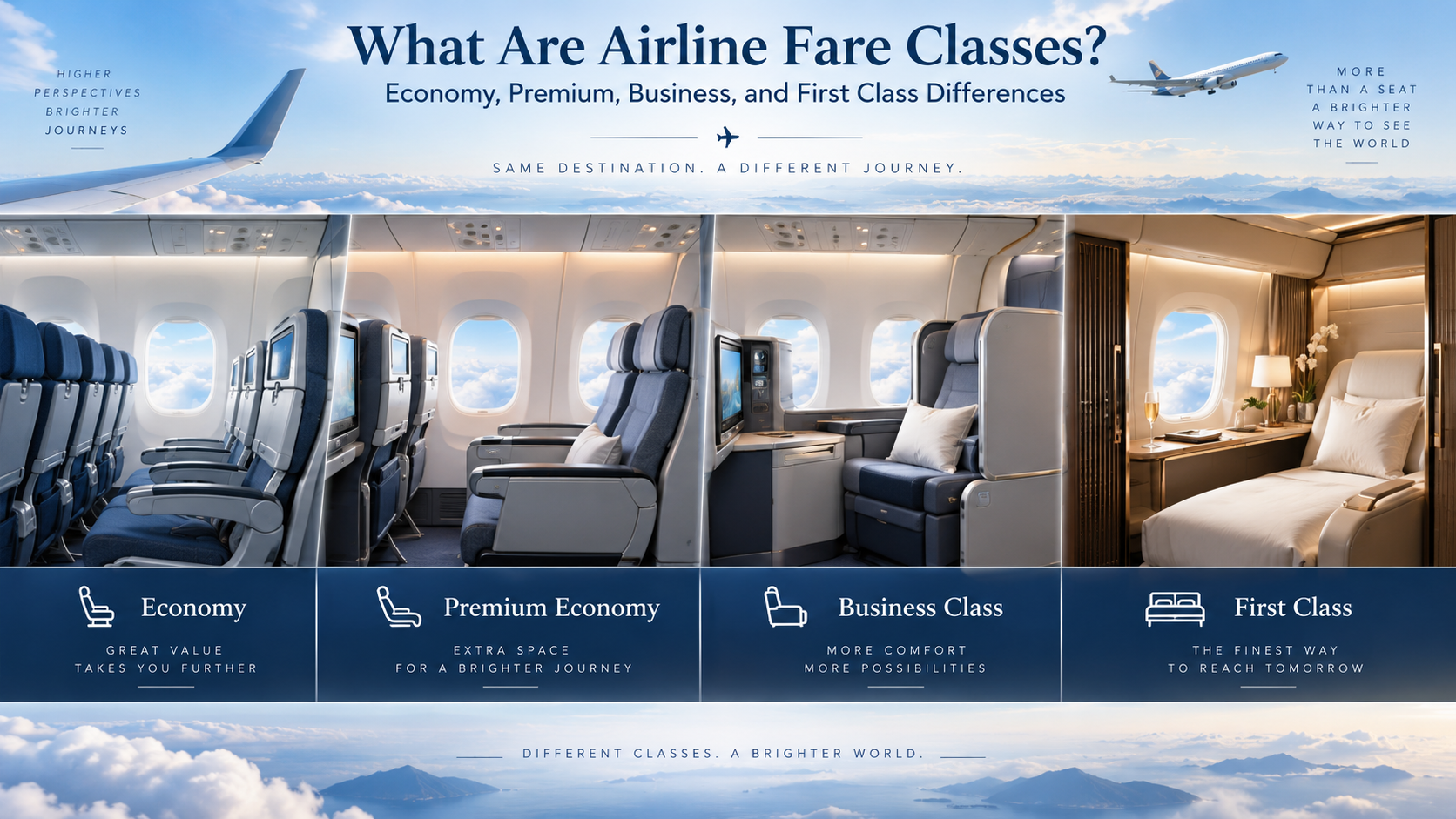
The distinction between a cabin class and a booking class rests on physical space versus ticket rules.
- Cabin Class: This refers to the physical seating section inside the aircraft. The four standard cabin classes are Economy Class, Premium Economy Class, Business Class, and First Class.
- Booking Class (Fare Class): This refers to the specific single-letter code assigned to your ticket within that physical cabin.
Two passengers sitting next to each other in the same economy cabin class may hold entirely different booking code letters. A passenger holding a Y class ticket paid a higher price but receives full refundability and free date changes. A passenger holding an X or V class ticket paid a discounted base fare but faces non-refundable terms and high re-booking fees.
What is a fare basis code?
A fare basis code is an alphanumeric string containing 3 to 8 characters that defines the exact rules, restrictions, and pricing structure of an airline ticket. While a booking class is represented by a single letter, the fare basis code provides complete instructions to travel agents and computer reservation systems.
The first letter of any fare basis code is always the primary booking code letter. The remaining characters indicate specific ticket conditions:
- First Character: Primary booking class letter (for example, Y or J).
- Middle Characters: Seasonal codes, advance purchase requirements, or minimum stay rules (for example, 7 for 7-day advance purchase, H for high season).
- Final Characters: Ticket restrictions such as NR (Non-Refundable), CH (Child fare), or IN (Infant fare).
For example, a fare basis code of Y7NR means the ticket is booked in Y economy class, required a 7-day advance purchase, and is Non-Refundable (NR).
What are the main cabin fare classes in airlines?
The four main cabin fare classes are Economy Class, Premium Economy Class, Business Class, and First Class. Each cabin offers distinct seating comfort, meal services, baggage limits, and lounge access, with prices increasing from Economy to First Class.
Airlines utilize standard letter codes across the aviation industry to distinguish between different cabin levels and pricing tiers. While individual airlines maintain minor variations in their internal systems, major booking platforms and Global Distribution Systems (GDS) follow standardized letter groupings.
The following table summarizes the primary single-letter booking codes used across the four major cabin categories:
| Cabin Category | Primary Full-Fare Code | Discounted & Promotional Fare Codes | Key Ticket Characteristics |
|---|---|---|---|
| Economy Class | Y, B, M, H | K, L, Q, V, T, S, N, X | Standard legroom, basic meal service, paid seat selection on discount codes |
| Premium Economy | W | P | Extra legroom, wider seat pitch, priority boarding, enhanced meals |
| Business Class | J, C | D, I, Z | Lie-flat seats, gourmet dining, lounge access, high baggage limit |
| First Class | F | A | Private suites, personalized dining, luxury lounge access, priority escort |
Economy Class fare codes (Y, B, M, H, K, L, Q, V, T, S, N, X)
Economy class forms the largest seating section on commercial aircraft. Airlines divide economy class into several sub-tiers to maximize revenue from budget travelers and corporate flyers:
- Y Class: The universal industry code for full-fare economy. Tickets booked under Y class are the most expensive economy seats. They offer 100% refundability, free date modifications, maximum frequent flyer miles, and high flight upgrade eligibility.
- B, M, H Codes: High-tier economy fare classes. These tickets carry flexible change terms and moderate cancellation charges. They are frequently purchased by business travelers booking on short notice.
- K, L, Q, V, T, S, N Codes: Standard discounted economy fare classes. These tickets represent typical tourist fares. They require advance purchase and carry date change penalties.
- X Class: Deeply discounted or award redemption economy code. Tickets under X class are often non-refundable, non-changeable, and earn zero frequent flyer points.
Premium Economy Class fare codes (W, P)
Premium Economy bridges the comfort and price gap between Economy Class and Business Class. Travelers seeking additional comfort without paying full business fares select this cabin option. For a detailed feature breakdown, read our comprehensive economy vs premium economy comparison.
- W Class: The primary booking code for full-fare Premium Economy. W class includes wider seats, 38-inch legroom pitch, dedicated premium check-in counters, and increased checked baggage allowance.
- P Class: Discounted Premium Economy booking code. P class offers identical physical seat comfort but carries stricter cancellation rules and lower mileage accrual rates.
Business Class fare codes (J, C, D, I, Z)
Business Class targets corporate travelers and premium leisure passengers. It focuses on productivity, rest, and premium airport service. To analyze cabin amenities deeply, view our guide on business class vs first class amenities.
- J Class: Full-fare Business Class. J class represents the highest flexible business tier with unrestricted refunds and maximum status point earnings.
- C Class: High-tier flexible Business Class ticket used for corporate contracts and flexible international itineraries.
- D, Z Codes: Discounted Business Class fares. Travelers purchasing non-refundable business class promotions receive full lie-flat seats and lounge access at lower costs.
- I Class: Business Class award ticket code used for frequent flyer point redemptions and promotional upgrades.
First Class fare codes (F, A)
First Class represents the ultimate tier of commercial air travel. It features private enclosed suites, dedicated concierge services, and exclusive airport transfers.
- F Class: Full-fare First Class. F class tickets provide complete flexibility, luxurious private lounges, and multi-course dining prepared by executive chefs.
- A Class: Discounted First Class or promotional first-class seat inventory. A class provides identical onboard luxury but applies change fees for date modifications.
How do fare classes work on Indian airlines?
Indian airlines group single-letter fare codes into branded fare families like Saver, Flexi, and Super 6E. These categories determine seat selection fees, meal inclusions, date change charges, and refund amounts under DGCA passenger protection guidelines.
Domestic air travel in India operates primarily through low-cost carriers (LCCs) alongside full-service airlines. Rather than displaying complex single-letter codes directly during consumer searches, Indian carriers group booking letters into clear fare families during booking.
Understanding these domestic fare options helps travelers choose between low price points and flexible ticket terms.
IndiGo fare classes explained (Saver vs Flexi Plus vs Super 6E)
IndiGo is India’s largest domestic carrier. IndiGo categorizes its aircraft inventory into three primary fare families:
- Saver Fare (Discount Codes: K, L, V, Q):
- Price: Lowest entry fare.
- Baggage: 15 kg checked baggage allowance + 7 kg hand baggage.
- Seat Selection Fee: Standard seat selection fee applies for preferred seats.
- Changes & Refunds: Standard cancellation charges apply. Date changes incur re-booking fees plus fare differences.
- Flexi Plus Fare (Flexible Codes: H, M, B):
- Price: 10% to 15% higher than Saver fare.
- Seat Selection: Free standard seat selection included.
- Meals: Complimentary snacks and beverage included.
- Changes: Zero date change fees (travelers pay only fare difference if applicable).
- Super 6E Fare (Premium Business Tier: J, C):
- Price: Premium pricing tier on select routes.
- Comfort: Dedicated cabin section with extra legroom and empty middle seats on select flights.
- Privileges: 25 kg baggage allowance, priority check-in, priority baggage handling, free seat selection, and gourmet hot meals.
Air India fare classes explained (Value vs Flex vs Super Flex)
Air India operates as a full-service carrier offering Economy Class, Premium Economy, and Business Class across domestic and international sectors. Air India structures domestic fares into distinct tiers:
- Value Tier (Economy Codes: U, T, S): Lowest pricing tier. Includes 15 kg checked baggage and complimentary meals. Date changes and cancellations carry standard fees.
- Flex Tier (Economy Codes: H, Q, V): Moderate flexibility tier. Offers lower date change penalties and free standard seat assignment.
- Super Flex Tier (Economy Codes: Y, B): Full-fare tier. Provides 100% refundability (minus nominal service charge), free date changes, and maximum frequent flyer mileage accumulation under the Flying Returns program.
SpiceJet and Akasa Air fare categories
Low-cost carriers SpiceJet and Akasa Air implement similar fare classification models:
- SpiceJet: Offers SpiceSaver (standard economy), SpiceFlex (free seat selection + zero change fee), and SpiceMax (extra legroom seats, priority baggage, free meals).
- Akasa Air: Offers Saver (budget economy) and Flexi (discounted change fees, complimentary seat selection, complimentary meal).
All Indian carriers operate under regulatory supervision. To review your passenger protection rights during cancellations, check our detailed overview of DGCA flight cancellation refund rules.
Why do airline fare classes matter for travelers?
Airline fare classes matter because they dictate ticket refundability, date change fees, baggage allowances, frequent flyer point earnings, and upgrade eligibility. Checking your fare class code before booking prevents unexpected costs when modifying travel plans.
Selecting an airline ticket based solely on the final display price can lead to hidden costs if your travel plans change. The single-letter fare class attached to your ticket governs your contract of carriage with the airline.
Ticket refundability and cancellation charges
Ticket flexibility directly correlates with your booking code letter.
- Full-Fare Booking Codes (Y, J, F): Offer complete ticket refundability if you cancel your flight. They permit date changes without imposing administrative penalties.
- Discounted Booking Codes (K, L, V, X): Are non-refundable or carry substantial cancellation fees. When canceling a discount fare ticket, airlines refund only government taxes, retaining the base fare component.
Under DGCA refund rules in India, if you cancel a domestic ticket within 24 hours of booking (for flights departing at least 7 days later), airlines must provide a full refund without imposing cancellation penalties, regardless of the fare class.
Frequent flyer points and mile earnings
Airline loyalty programs allocate frequent flyer miles based on the booking code letter printed on your e-ticket:
- 100% to 150% Miles: Earned on full-fare economy codes (Y, B) and premium business codes (J, C).
- 50% to 75% Miles: Earned on mid-tier discount codes (M, H, Q).
- 0% to 25% Miles: Earned on deeply discounted codes (V, T, K, X).
Travelers aiming to achieve elite tier status should verify that their selected fare class qualifies for mileage accumulation before purchasing.
Flight upgrade eligibility by booking code
Upgrading from economy class to business class using frequent flyer miles or upgrade vouchers depends strictly on your original booking class letter.
Airlines enforce clear rules regarding flight upgrade eligibility:
- Eligible Codes: Tickets booked under full-fare economy (Y, B, M) qualify for mileage upgrades or standby upgrades at the airport.
- Ineligible Codes: Tickets booked under deeply discounted codes (N, X, V) are restricted from upgrades. Airlines prohibit passengers holding deep-discount tickets from upgrading to business class, even if open seats exist in the premium cabin.
Understanding how inventory allocation affects ticket availability is key to smart flight planning. Learn more by reading our guide on how airline pricing algorithms work.
How to find your fare class code on a flight ticket?
You can find your fare class code on your e-ticket receipt, boarding pass, or booking confirmation email. Look for the single letter next to “Class” or inspect the first letter of the “Fare Basis Code” printed on the ticket.
Identifying your booking code letter takes only a few seconds once you know where to look on your booking documents.
Locating fare code on flight booking platforms
When booking through Online Travel Agencies (OTAs) or airline websites, the fare class letter appears before payment confirmation:
- Search Results Page: Click on “Flight Details” or “Fare Details” beneath the flight itinerary.
- Class Indicator: Look for a line displaying “Class: Economy (Y)” or “Booking Code: J”.
- Fare Rules Pop-up: Review the detailed fare conditions. The first letter of the listed Fare Basis Code indicates your exact fare class bucket.
Comparing top platforms helps you find transparent booking options. Explore our review of the best domestic airlines in India to evaluate service quality across carriers.
Locating fare code on physical and mobile boarding passes
After completing web check-in or airport check-in, your single-letter fare code appears directly on your boarding pass:
- Physical Paper Boarding Pass: Look for the box labeled CLASS or CL. A single letter (Y, J, W, or F) will be printed inside or next to this box.
- Mobile PDF / Apple Wallet Pass: The single-letter code appears adjacent to your seat number or flight number under “Booking Class”.
- E-Ticket Tax Invoice: Inspect the line item breakdown. The fare basis code (such as YIP1NR) will be listed next to passenger details. The first letter (Y) confirms your fare class.
Airline fare classes comparison table
The following comprehensive comparison table details how single-letter fare classes map across cabin categories, ticket flexibility terms, baggage inclusions, and mileage earnings:
| Booking Code Letter | Cabin Category | Ticket Flexibility & Refund Terms | Baggage Allowance (Domestic / Intl) | Upgrade Eligibility | Mileage Accrual Rate |
|---|---|---|---|---|---|
| Y | Full-Fare Economy | 100% Refundable, Free Date Changes | 15–25 kg / 2 Pieces (23 kg each) | High | 100% – 125% |
| B, M, H | Flexible Economy | Refundable with minor fee, Low change fee | 15 kg / 2 Pieces | Moderate | 75% – 100% |
| K, L, Q, V | Discount Economy | Cancellation fee applies, Change fee applies | 15 kg / 1 Piece (23 kg) | Low | 50% – 75% |
| T, S, N, X | Deep Discount Economy | Non-Refundable, High change fee or restricted | 15 kg / 1 Piece | Ineligible | 0% – 25% |
| W | Full Premium Economy | Refundable, Free or low-cost changes | 20–30 kg / 2 Pieces (23 kg each) | High (to Business) | 110% – 130% |
| P | Discount Premium Economy | Cancellation fee applies, Moderate change fee | 20 kg / 2 Pieces | Moderate | 80% – 100% |
| J, C | Full Business Class | Fully Refundable, Free Date Changes | 35–40 kg / 2 Pieces (32 kg each) | High (to First) | 150% – 200% |
| D, Z | Discount Business Class | Cancellation fee applies, Change fee applies | 30–35 kg / 2 Pieces (32 kg each) | Moderate | 110% – 130% |
| I | Business Award Redemption | Fee applies for redeposit / date change | 30–35 kg / 2 Pieces | Ineligible | 0% (Award) |
| F | Full First Class | Fully Refundable, Unlimited Free Changes | 40–50 kg / 3 Pieces (32 kg each) | N/A (Top Tier) | 200% – 300% |
| A | Discount First Class | Refundable with fee, Change fee applies | 40 kg / 3 Pieces | N/A | 150% – 200% |
To avoid unexpected airport charges regardless of your ticket tier, compare standard carrier rules in our complete guide to airline baggage fees comparison.
Frequently asked questions about airline fare classes
What is the cheapest airline fare class letter?
X, N, and T are generally the cheapest airline fare class letters in economy class. Airlines utilize these deep-discount inventory buckets for promotional sales, flash deals, and early-bird advance purchases. Tickets booked under these letters carry strict non-refundable terms, high change penalties, and zero mileage earnings.
Does fare class affect baggage allowance on Indian flights?
Yes. Fare class directly affects checked baggage allowance and hand baggage limits on Indian flights. Full-fare economy codes (Y) and business class codes (J, Super 6E) provide higher baggage allowances (25 kg to 40 kg). Discounted economy fare codes (Saver fares) limit domestic checked baggage to 15 kg per passenger.
Can you upgrade a discount economy ticket to business class?
No. Most airlines restrict discount economy tickets (booked under codes like X, V, or T) from upgrading to business class using frequent flyer miles. Upgrade eligibility requires holding a flexible or full-fare economy ticket booked under single-letter codes such as Y, B, or M.
What is the difference between Y and J class in flights?
Y class represents full-fare Economy Class, while J class represents full-fare Business Class. Holding a Y class ticket places you in the standard economy cabin with flexible ticket terms. Holding a J class ticket grants you access to the premium business cabin with lie-flat seats, gourmet dining, priority boarding, and lounge access.
Is basic economy a separate fare class?
Yes. Basic economy functions as a highly restricted fare class category within the economy cabin. Represented by booking letters such as E or B on select international carriers, basic economy restricts passengers from bringing overhead carry-on bags, selecting seats in advance, or modifying travel dates.
Key Takeaways for Smart Travelers
- Always Check the Single-Letter Code: Inspect the letter code on your booking screen to understand whether your ticket is flexible or non-refundable.
- Match Fare Families to Travel Needs: Choose Saver fares if your travel dates are fixed; choose Flexi fares if your schedule may require modifications.
- Know Your DGCA Rights: Remember that Indian aviation regulations protect travelers with full refunds within 24 hours of booking for flights booked 7 days ahead of departure.
- Protect Loyalty Earnings: Verify that your selected booking code earns full mileage points if you are accumulating status with frequent flyer programs.