Booking hotels for a destination wedding in India requires strategic venue selection, advance room block contracting, group rate negotiation, and detailed food and beverage (F&B) management. Destination weddings involve multi-day celebrations spanning Mehendi, Sangeet, and Pheras. Securing hotel accommodations for 50 to 200 guests demands careful contract planning to control costs and deliver exceptional hospitality.
Mastering hotel room blocks, attrition clauses, and value-added negotiations ensures your wedding budget achieves maximum value while preventing unexpected financial penalties.
When should you book a hotel for a destination wedding in India?
You should book a hotel for a destination wedding in India 9 to 15 months in advance. Booking early secures preferred weekend dates during peak wedding season, locks in group room rates, and allows adequate time for guest RSVP management.
The Indian wedding calendar revolves around auspicious wedding dates (Muhurat dates) concentrated between October and March. Popular wedding destinations such as Udaipur, Jaipur, Goa, and Mussoorie experience high demand during these peak winter months.

Initiating hotel searches 12 to 18 months prior to your wedding date gives host families maximum leverage. Booking early allows you to negotiate competitive group tariffs before public inventory fills up.
Key factors when choosing a destination wedding hotel
Selecting the right hotel venue depends on physical infrastructure and operational flexibility:
- Guest Capacity and Room Allocation: The hotel must offer sufficient inventory to accommodate your core guest list under one roof.
- Banquet Space Diversity: The property must feature multiple distinct event spaces, such as an outdoor banquet lawn for Sangeet, poolside areas for Mehendi, and traditional courtyards for Pheras.
- Airport and Transit Proximity: Evaluating transfer times from the nearest airport or railway station minimizes guest fatigue.
- Catering and Kitchen Flexibility: Verifying whether the hotel permits specialized regional caterers (such as Maharaj cooks for pure vegetarian or Jain menus) is critical for traditional Indian families.
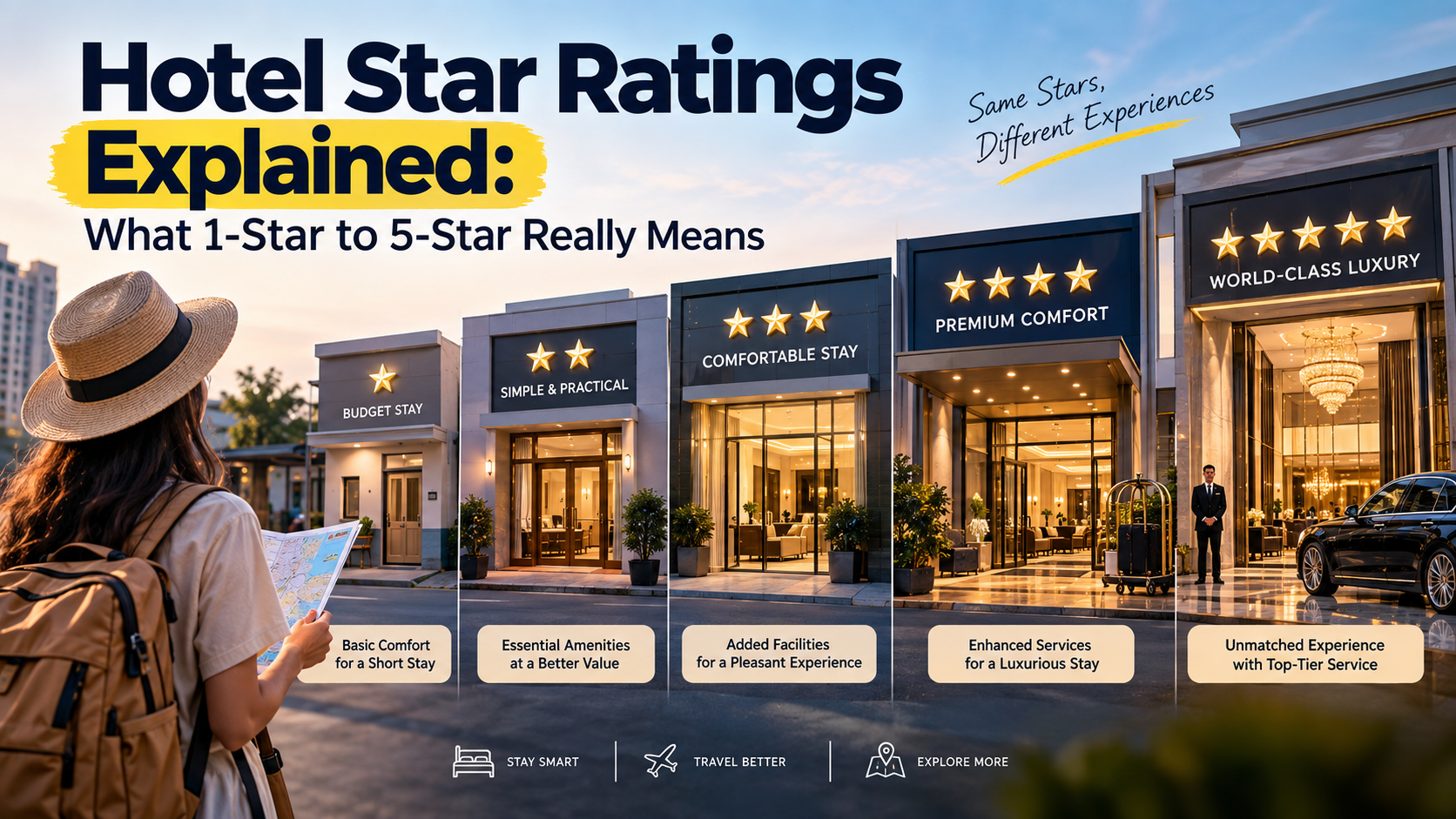
To understand basic hotel property standards before inspecting venues, read our guide on hotel star ratings explained.
Top destination wedding locations in India (Rajasthan, Goa, Kerala, Hills)
India offers diverse geographical regions for destination weddings, each featuring distinct pricing dynamics:
- Rajasthan (Udaipur, Jaipur, Jodhpur): Offers royal palaces, grand havelis, and heritage fort venues. Ideal for regal multi-day celebrations with royal hospitality. To explore historic venue options, check our guide on the best heritage hotels in India.
- Goa (North & South Goa): Delivers beachfront lawns, sunset ocean view mandaps, and relaxed resort vibes. South Goa resorts provide sprawling private beach access for large gatherings.
- Kerala (Kovalam, Kumarakom): Features backwater resorts, coconut grove lawns, and serene houseboats for intimate tropical weddings.
- Himalayan Foothills (Mussoorie, Rishikesh, Jim Corbett): Offers mountain valley views, riverside lawns, and fresh air for scenic nature weddings.
How do hotel room blocks work for destination weddings?
Hotel room blocks reserve a specific group of bedrooms at a fixed discounted rate for wedding guests. The host signs a contract establishing guaranteed room counts, deposit timelines, group discount percentages, and final release cutoff dates.
A room block is a contractual agreement between the wedding host and the hotel. The hotel holds a designated number of guest rooms exclusively for your wedding attendees, preventing outside public bookings from filling the hotel on your event dates.
Securing a room block unlocks a group discount rate, typically providing 15% to 30% savings compared to published online rates.
Difference between courtesy room blocks and guaranteed room blocks
Hotels offer two distinct room block structures for group bookings:
- Courtesy Room Block (Courtesy Block):
- Financial Commitment: Zero financial liability for unbooked rooms.
- Inventory Size: Limited to 10 to 20 rooms maximum.
- Mechanism: The hotel holds rooms at a discounted rate until a specified cutoff date (usually 30 to 45 days before the event). Unbooked rooms return to general public inventory without financial penalty to the host.
- Guaranteed Group Block (Guaranteed Block):
- Financial Commitment: High financial liability backed by a signed contract and advance deposit payments.
- Inventory Size: Covers 30 to 150+ rooms or full property buyouts.
- Mechanism: The host guarantees that guests will book a set percentage of the contracted rooms. If guests fail to reserve the agreed room count, the host pays penalty fees under an attrition clause.
Large destination weddings in India requiring 40+ rooms operate exclusively through Guaranteed Group Block contracts.
How many rooms should you block for wedding guests?
Determining the correct room count prevents paying for unused capacity:
- Calculate Double Occupancy: Most wedding guests travel as couples or families. Divide your total guest count by 2 to estimate required room counts (for example, 150 guests require approximately 75 to 80 rooms).
- Apply the 80% Rule: Block rooms for 80% of your confirmed out-of-town guest list. Local guests or nearby relatives rarely require hotel stay accommodations.
- Phased Block Extensions: Contract a baseline block for 80% of expected demand, adding a contract clause allowing room block expansion at the same discounted rate if RSVPs exceed expectations early.
For additional strategies on managing group travel arrangements, read our guide on hotel booking group travel tips.
How do you negotiate hotel rates for a destination wedding?
Negotiate hotel rates for a destination wedding by leveraging overall food and beverage spend rather than room tariffs alone. Request complimentary suite upgrades for the couple, free airport transfers, waived venue rental fees, and complimentary site inspection nights.
Hotel sales departments earn significant profit margins on banquet catering, high-volume dining, and beverage sales during multi-day weddings. Smart negotiators use total event revenue potential to secure lower room tariffs and waived venue fees.
Direct all group negotiations to the hotel Director of Sales or General Manager rather than front desk reservation staff.
Leveraging total F&B spend to waive venue hall rental fees
Hotel sales departments divide event charges into room tariffs, banquet hall rental fees, and Food & Beverage (F&B) per-plate charges.
- F&B Minimum Spend Guarantee: Agreeing to a substantial F&B minimum spend across Mehendi lunches, Sangeet dinners, and Wedding receptions gives you leverage to demand zero venue rental charges.
- Waived Banquet Charges: Ensure your contract explicitly states that meeting hall fees, lawn usage charges, and outdoor venue rental fees are waived completely upon reaching the F&B spend threshold.
Never pay standalone venue rental fees when spending millions of rupees on hotel banquet catering.
Requesting value-added perks (suite upgrades, spa discounts, free breakfast)
When hotels refuse to reduce room tariffs further due to strict brand rate floors, request high-value complimentary add-on services:
- Bridal Suite Upgrades: Request complimentary suite upgrades for the bride and groom, as well as upgraded rooms for both sets of parents throughout the stay.
- Complimentary Recce Site Visit: Request a free 1 to 2 night recce site visit stay for the couple and family planners to conduct food tastings and decor walk-throughs prior to the wedding.
- Guest Airport Transfers: Secure complimentary group coach shuttles between the airport and hotel for arriving and departing guests.
- Buffet Breakfast Inclusion: Ensure all room block tariffs include full daily buffet breakfast for all occupants.
To evaluate when premium hotel services deliver genuine financial value, view our analysis on luxury hotel price analysis.
Booking during shoulder seasons for 20% to 35% savings
Timing your wedding dates during shoulder seasons yields massive cost savings:
- Peak Season (November to February): Maximum room tariffs, strict deposit terms, high F&B minimums across Rajasthan and Goa.
- Shoulder Season (September, October, March, April): Pleasant weather, 20% to 35% lower room tariffs, flexible negotiation terms, lower attrition thresholds.
- Monsoon Season (July to August): Deepest discounts across hill stations and coastal resorts, though outdoor events require covered backup halls.
What contract clauses must you check before signing a wedding hotel agreement?
Key wedding hotel contract clauses include attrition limits, cancellation terms, outside vendor royalty fees, corkage charges, and overtime sound restrictions. Reviewing these clauses prevents unexpected financial penalties during multi-day wedding celebrations.
A hotel contract is a legally binding document. Verbal promises made by sales managers during site visits hold no legal weight unless written into the signed agreement.
The following checklist details the most critical contract clauses requiring careful review:
| Contract Clause | Standard Hotel Draft Terms | Recommended Negotiated Target Terms | Financial Risk Level |
|---|---|---|---|
| Attrition Clause | 90% to 95% room pickup required | 80% to 85% room pickup required | High |
| Cutoff Release Date | 60 days before event | 30 to 45 days before event | High |
| Outside Vendor Royalty | ₹25,000 to ₹1,000,000 per day fee | Waived or capped nominal fee | High |
| Corkage Fee | Full bottle retail price markup | Fixed per-person fee or waived corkage | Medium |
| Overtime Sound Limit | Strict 10:00 PM outdoor shutdown | Indoor acoustic hall backup after 10 PM | Medium |
| Recce Site Visit Stay | Charged at full published rate | Complimentary 2-night stay for 4 pax | Low |
Attrition rate and unbooked room release cutoff dates
The attrition clause protects the hotel if your guests fail to book the contracted room count.
- Understanding Attrition: If you contract 100 rooms with an 85% attrition clause, you guarantee that guests will pay for at least 85 rooms. If guests book only 70 rooms, you must pay the room tariff for the 15 missing rooms.
- Negotiate Lower Pickup Targets: Always negotiate the attrition pickup threshold down to 80% or 85%.
- Enforce a Clear Cutoff Date: Ensure the contract includes a firm cutoff date 30 to 45 days before the wedding. On this date, any unbooked rooms in your block above the 85% attrition limit return to the hotel for public sale without penalty to you.
Outside vendor royalty fees (decorators, sound, caterers)
Hotels frequently charge an outside vendor royalty fee if you hire external decorators, sound engineers, light technicians, or wedding planners instead of using the hotel’s expensive in-house panel vendors.
- Identify Hidden Charges: In-house sales drafts may charge ₹50,000 to ₹2,000,000 per day as royalty fees for bringing outside decor vendors.
- Contractual Protection: Negotiate to waive or cap outside vendor fees before signing. Specify that external decorators receive full access to banquet halls 8 to 12 hours prior to event start times without extra staging fees.
Corkage fees for outside alcohol and food safety policies
Serving alcohol at Indian weddings requires clear liquor license and corkage agreements:
- Corkage Fee Negotiation: If you supply your own liquor for Sangeet and reception events, hotels charge a corkage fee per bottle or per person. Negotiate a flat per-person corkage rate rather than high per-bottle charges.
- State Excise Licenses: Confirm whether the hotel will process the mandatory temporary state liquor permit (such as L-49 in Delhi or FL-4 in Maharashtra) on your behalf.
- Outside Food Constraints: Due to food safety standards, hotels prohibit outside perishable food in main banquets, though exceptions can be contracted for specialized traditional sweet counters (Mithai) or regional chaat stalls.
Weather backup halls and outdoor decibel sound limits
Government environmental regulations in India strictly enforce outdoor decibel sound limits after 10:00 PM.
- Sound Shutdown Rules: Outdoor banquet lawn music and DJ systems must shut down or reduce volume by 10:00 PM under Supreme Court noise guidelines.
- Indoor Event Transfer: Ensure your contract guarantees an air-conditioned indoor banquet hall or soundproof nightclub space for late-night Sangeet after-parties from 10:00 PM onwards at no extra venue charge.
- Weather Backup Guarantee: Mandate a free indoor backup hall allocation in case rain or extreme weather disrupts outdoor Mehendi or Pheras events.
Is a full resort buyout better than booking a partial room block?
A full resort buyout is better if you require complete privacy, exclusive venue access, and customized event schedules for 50 to 100 rooms. Partial room blocks work better for large 5-star city hotels hosting over 200 guests.
Choosing between an exclusive resort buyout and a partial room block within a large hotel impacts guest experience, budget control, and event privacy.
Benefits of exclusive resort buyouts for multi-day events
A resort buyout involves booking 100% of the property’s guest rooms and event spaces for the duration of your wedding.
Key advantages of a full property buyout include:
- Complete Privacy: No outside hotel guests share your swimming pool, restaurants, gardens, or lobbies.
- Total Schedule Freedom: You can customize music timing, pool party dress codes, procession (Baraat) routes, and late-night gatherings without disturbing non-wedding guests.
- Branding and Personalization: The hotel allows custom entrance signage, branded keycards, personalized welcome drinks, and customized staff uniforms across the property.
Buyouts work exceptionally well for boutique heritage palaces in Rajasthan or beach resorts in Goa with 40 to 90 total rooms. To evaluate resort packages, read our complete all inclusive resorts guide.
Managing shared public spaces during partial hotel room blocks
When hosting a wedding at a large 300-room city hotel (such as Marriott, Taj, or Hyatt) where you block only 80 rooms, you share public areas with corporate and leisure guests:
- Designated Private Venues: Ensure your contract assigns dedicated, private entrances and enclosed banquet lawns so non-wedding guests cannot wander into your functions.
- Noise Restrictions: Partial blocks enforce strict noise policies in guest corridors to prevent complaints from outside hotel residents.
- Elevator and Lobby Logistics: Request dedicated check-in desks in private foyers to handle guest arrival kits without clogging main hotel lobbies.
Destination wedding hotel cost breakdown and comparison table
The following table provides benchmark cost ranges, Hotel Ratings for hosting a 2-night, 3-event destination wedding in India for 150 guests across different venue tiers:
| Destination Venue Tier | Average Room Rate per Night | 2-Night Room Block Cost (75 Rooms) | F&B Cost per Guest (3 Events) | Estimated Total Hotel Budget (Rooms + F&B) |
|---|---|---|---|---|
| 3-Star Resort (Goa / Jim Corbett) | ₹3,500 – ₹6,000 | ₹5.25L – ₹9.0L | ₹2,500 – ₹4,000 | ₹9.0L – ₹15.0L |
| 4-Star Upscale Hotel (Jaipur / Kerala) | ₹7,000 – ₹12,000 | ₹10.5L – ₹18.0L | ₹4,500 – ₹7,000 | ₹17.0L – ₹28.5L |
| 5-Star Luxury Resort (Udaipur / Goa) | ₹14,000 – ₹25,000 | ₹21.0L – ₹37.5L | ₹8,000 – ₹14,000 | ₹33.0L – ₹58.5L |
| Heritage Grand Palace (Udaipur / Jodhpur) | ₹25,000 – ₹55,000+ | ₹37.5L – ₹82.5L+ | ₹12,000 – ₹22,000 | ₹55.0L – ₹1.15 Cr+ |
| 5-Star Full Resort Buyout (60 Rooms) | Lump sum rate | ₹18.0L – ₹35.0L | Included in F&B spend | ₹30.0L – ₹55.0L total package |
To compare online booking tariffs against direct hotel sales quotes, read our guide on OTA vs direct hotel booking comparison.
Frequently asked questions about booking hotels for destination weddings
Who pays for guest rooms in an Indian destination wedding?
In traditional Indian destination weddings, the host family pays for guest room accommodations. The bride’s and groom’s families contract the room block and cover room tariffs, breakfast, and event meals. However, guests typically cover their own personal travel transport (flights or train tickets) to reach the wedding destination.
What is a recce site visit and is it free?
A recce site visit is a preliminary inspection trip taken by the couple and family planners to evaluate hotel venues, taste food menus, and check room conditions. While hotels charge standard room rates for initial visits, sales managers routinely deduct recce stay costs or provide complimentary recce nights once you sign the final wedding contract.
What is the attrition rate in a hotel group contract?
The attrition rate is the percentage of contracted rooms that your group must occupy or pay for. For example, an 80% attrition clause on a 100-room block means you must fill at least 80 rooms. If your guests book only 70 rooms, you must pay the contracted tariff for the 10 unbooked rooms to satisfy the 80% commitment.
Can you bring your own alcohol to a destination wedding hotel?
Yes, most hotels allow you to bring outside alcohol if you pay a corkage fee and obtain a temporary state liquor permit. You must negotiate corkage charges during contract signing. Ensure the hotel agrees to handle liquor license processing through local excise departments.
What is the cheapest month for a destination wedding in India?
July, August, and September (the monsoon season) offer the lowest hotel rates for destination weddings in India. Hotels offer 30% to 50% discounts on room tariffs and banquet packages during these months. For pleasant dry weather with moderate pricing, April and October represent excellent shoulder season choices.
Key Takeaways for Wedding Planners
- Contract Early: Secure your hotel venue 9 to 15 months ahead to lock in prime weekend dates during peak wedding season.
- Negotiate F&B Over Rooms: Use high catering spend to eliminate venue hall rental charges and secure complimentary suite upgrades.
- Protect Against Attrition: Insist on an 80% to 85% attrition threshold with a firm 30 to 45 day room release cutoff date.
- Audit Hidden Contract Fees: Cap outside vendor royalty fees, negotiate flat corkage charges, and secure guaranteed indoor weather backup spaces before signing.