A hotel star rating system is an official classification structure that measures hotel property infrastructure, room size, guest amenities, food services, and hygiene standards. Ratings range from 1-star basic stays to 5-star deluxe luxury accommodations. Understanding star ratings helps travelers select appropriate lodgings, evaluate price options, and avoid unexpected service disappointments.
While star ratings provide standardized guidelines for room dimensions and property features, classification rules vary between international travel bodies, online booking platforms, and government regulatory agencies.
What is a hotel star rating system?
A hotel star rating system is an official classification structure that evaluates property infrastructure, room size, guest amenities, food services, and hygiene standards. Ratings range from 1-star basic stays to 5-star deluxe luxury accommodations.
A hotel star rating evaluates the physical infrastructure and service capacity of a hospitality property. Unlike guest review scores that measure customer satisfaction, star ratings measure tangible features. These features include minimum room dimensions, elevator availability, dining facilities, swimming pools, and round-the-clock staff support.
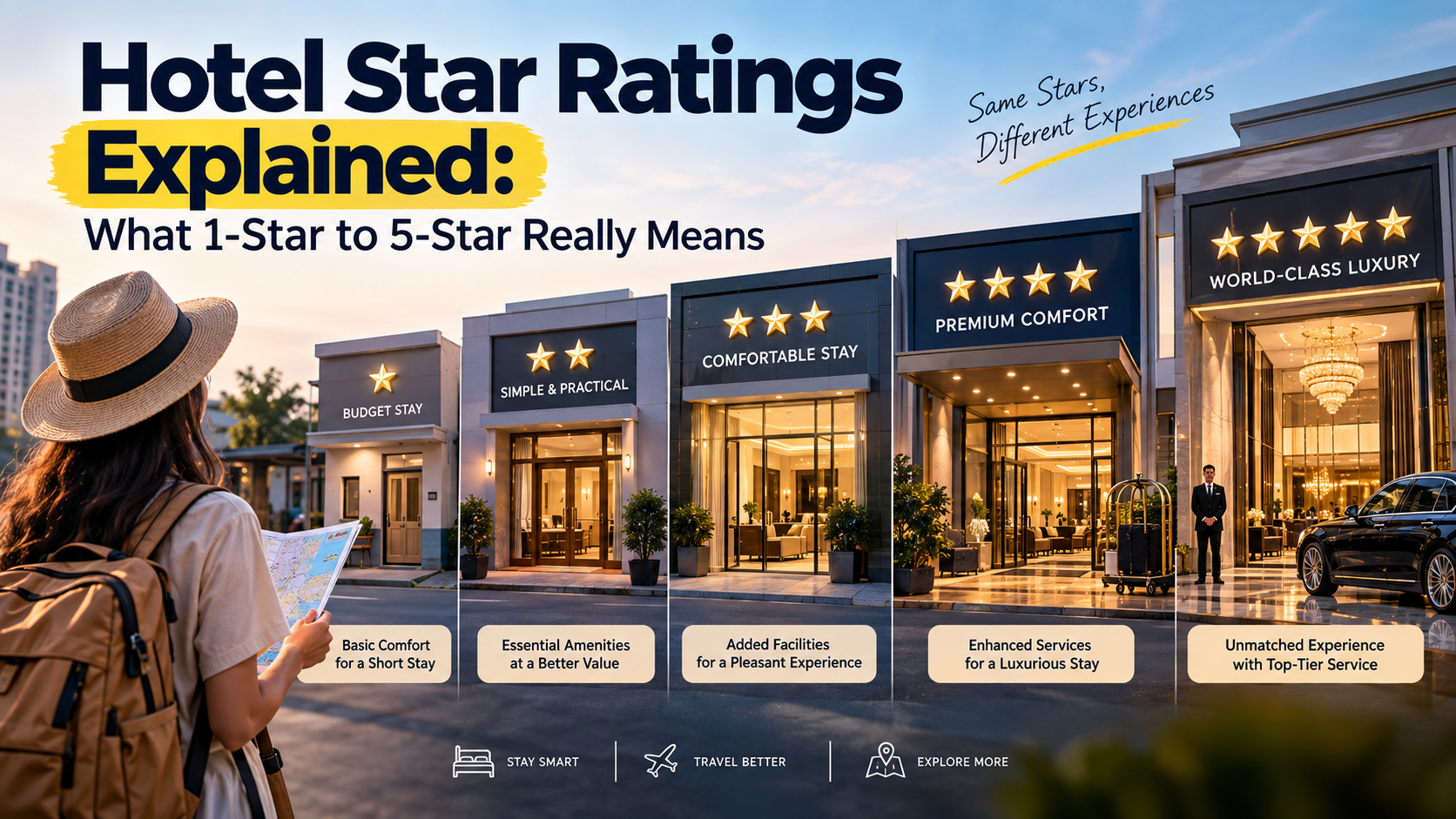
Higher star ratings indicate broader facility offerings and larger staff ratios per guest room. A 1-star property provides basic shelter and hygiene, whereas a 5-star hotel delivers comprehensive luxury, specialized concierge assistance, and fine dining.
Who determines hotel star ratings globally and in India?
Star ratings do not follow a single universal global organization. Different countries use independent rating authorities:
- United States: The American Automobile Association (AAA) uses Diamond ratings, while Forbes Travel Guide assigns Star ratings based on unannounced professional inspections.
- Europe: The Hotelstars Union operates a unified rating system across 21 European nations using standardized criteria.
- India: The Ministry of Tourism, Government of India, manages official hotel classification through a dedicated regulatory committee.
Private online booking platforms also generate their own internal rating scores, which can cause confusion for consumers comparing official government ratings against commercial search listings.
How the HRACC classification committee works in India
In India, official hotel classification operates under the Hotel & Restaurant Approval & Classification Committee (HRACC), functioning under the Ministry of Tourism.
Hoteliers apply voluntarily for official classification through the government NIDHI+ portal (National Integrated Database of Hospitality Industry). A specialized HRACC inspection team comprising Ministry officials, hospitality association representatives, and hotel management experts inspects the property.
The committee evaluates properties against strict HRACC guidelines:
- Infrastructure Evaluation: Measuring bedroom floor space, bathroom area, public areas, and emergency exit access.
- Service Assessment: Auditing front desk support, housekeeping service, food preparation safety, and laundry turnaround times.
- Mandatory Compliance: Verifying valid fire safety standards, environmental waste management systems, and differently-abled access facilities.
HRACC classification approvals remain valid for 5 years, after which properties must undergo re-inspection.
What is the difference between 1-star and 5-star hotels?
The difference between 1-star and 5-star hotels centers on room dimensions, dining options, service levels, and luxury amenities. 1-star hotels offer clean basic rooms, while 5-star hotels provide spacious suites, multi-cuisine restaurants, spas, and 24-hour concierge service.
Hotel star ratings divide properties into distinct comfort and service categories. Each star tier establishes specific baseline expectations for room features, guest security, and food services.
The following table summarizes the primary characteristics across all official star tiers:
| Star Rating Tier | Minimum Room Size (India) | Primary Dining Options | Key Facility Highlights | Target Guest Profile |
|---|---|---|---|---|
| 1-Star Hotel | 110 sq ft | Clean drinking water, external food vendor ties | Air-cooled/AC room, attached private bath | Solo backpackers, budget travelers |
| 2-Star Hotel | 110 sq ft | Basic breakfast room, beverage vending | In-room TV, telephone, daily housekeeping | Short-stay transit travelers |
| 3-Star Hotel | 120 sq ft | Full in-house dining restaurant, room service | Wi-Fi, elevator access, 24-hr front desk | Families, corporate travelers |
| 4-Star Hotel | 140 sq ft | Multi-cuisine restaurant, bar, 24-hr dining | Swimming pool, gym, valet parking | Upscale vacationers, business delegates |
| 5-Star Hotel | 200 sq ft | Multiple specialty restaurants, 24-hr dining | Luxury spa, health club, concierge service | Luxury travelers, foreign tourists |
| 5-Star Deluxe | 200 sq ft+ | Award-winning fine dining, executive lounges | Presidential suite rooms, personal butler | VVIPs, luxury connoisseurs |
1-Star Hotels: Basic amenities and essential comfort
1-Star hotels deliver low-cost accommodation focused on essential rest and basic cleanliness.
Rooms offer minimal floor space starting at 110 square feet in India. Facilities include a clean bed, fresh linen, wardrobe space, and an attached bathroom with 24-hour running water. 1-Star hotels rarely operate full restaurants on site, though they provide filtered drinking water and local food delivery arrangements.
Properties in this category cater to budget-conscious travelers seeking overnight accommodation without paying for secondary recreational facilities.
2-Star Hotels: Upgraded budget rooms with TV and phone
2-Star hotels upgrade the budget experience by introducing basic electronic amenities and improved room furnishings.
Guest rooms feature television sets, internal telephone communication to the front desk, and daily housekeeping service. Bathrooms supply basic toiletries and hot water facilities. Many 2-Star properties maintain a small breakfast room serving simple morning meals and hot beverages.
Travelers looking for clean, predictable accommodation at low rates select 2-star chain properties or well-maintained independent lodges.
3-Star Hotels: Mid-range comfort with in-house dining and Wi-Fi
3-Star hotels form the foundation of mid-range hospitality. They combine spacious room layouts with comprehensive guest conveniences.
Under Indian government rules, 3-Star hotel rooms must measure at least 120 square feet. Rooms feature air conditioning, high-speed Wi-Fi, work desks, tea and coffee makers, and electronic safes. Properties must operate a full-service in-house dining restaurant, provide room service during major meal hours, and maintain a 24-hour reception desk.
To compare how 3-star hotels stack up against alternative lodgings, explore our complete hotel vs homestay vs hostel comparison.
4-Star Hotels: Upscale properties with pools, gyms, and room service
4-Star hotels provide an upscale environment with premium interior design, broad dining options, and recreational facilities.
Minimum bedroom floor area increases to 140 square feet. Mandatory facilities include multi-cuisine dining restaurants, cocktail lounges, swimming pools, fitness centers, and business conference rooms. 4-Star properties offer 24-hour room service, laundry turnaround, and professional valet parking assistance.
Travelers booking 4-Star accommodations enjoy high comfort levels at rates below luxury 5-star prices.
5-Star & 5-Star Deluxe Hotels: Luxury suites, fine dining, and butler service
5-Star and 5-Star Deluxe hotels deliver elite hospitality, expansive architectural design, and highly personalized customer care.
Standard guest rooms start at a generous 200 square feet, expanding into plush suite rooms with separate living areas. Mandatory features include multiple specialty fine-dining venues, 24-hour room service, luxury wellness spas, temperature-controlled pools, and specialized concierge service.
5-Star Deluxe properties represent the top tier of international hospitality. They offer presidential suites, private butler support, executive airport transfers, and private helipads.
To understand when splurging on top-tier properties delivers real value, view our detailed luxury hotel price analysis.
How do Heritage hotel star ratings work in India?
Heritage hotel star ratings categorize historic palaces, forts, and havelis converted into accommodations. The Ministry of Tourism classifies these properties into Heritage Basic, Heritage Classic, and Heritage Grand based on architectural age, historic authenticity, and luxury services.
India possesses a unique hospitality category known as Heritage Hotels. Historic structures like royal palaces, majestic forts, and traditional havelis converted into guest accommodations receive special heritage ratings from the Ministry of Tourism.
Rather than enforcing rigid modern architectural layouts, the HRACC evaluates a heritage property based on historical preservation, traditional aesthetics, and guest service integration.
Heritage Basic properties (built between 1935 and 1950)
Heritage Basic covers historic residences and structures built between 1935 and 1950.
These properties preserve traditional architectural elements such as central courtyards, carved stone balconies, and antique furniture. Rooms provide modern air conditioning, private bathrooms, and clean amenities while maintaining historic character.
Heritage Basic hotels offer travelers authentic regional culture at affordable price points.
Heritage Classic properties (built between 1920 and 1935)
Heritage Classic applies to grand historical residences, ancestral mansions, and small forts built between 1920 and 1935.
Properties must retain traditional facades, historic grounds, and authentic period decor. Facilities include full-service dining rooms serving regional royal cuisines, manicured garden courtyards, and cultural performance evenings for guests.
Heritage Classic hotels combine mid-range luxury with immersive historical ambiance.
Heritage Grand properties (built prior to 1920 with palatial luxury)
Heritage Grand represents the pinnacle of historic luxury in India. This rating applies to magnificent royal palaces and formidable forts constructed prior to 1920.
Properties must demonstrate exceptional historic significance, palatial architecture, and pristine preservation. Guests experience world-class 5-star luxury including royal dining halls, antique-furnished suites, luxury spas, and personalized royal hospitality. World-famous properties like Taj Lake Palace in Udaipur and Umaid Bhawan Palace in Jodhpur exemplify the Heritage Grand category.
Why do online travel agency star ratings differ from official ratings?
Online travel agency star ratings differ from official ratings because platforms like MakeMyTrip and Booking.com use self-reported property details and guest feedback algorithms. Official ratings require rigorous physical site inspections by government committees like the HRACC.
A common point of confusion for hotel guests occurs when a property listed as a “4-Star Hotel” on an online booking app possesses no official government star accreditation.
Commercial booking portals and regulatory bodies use completely different evaluation methods.
How OTAs calculate property star ratings
Online Travel Agencies (OTAs) such as MakeMyTrip, Agoda, Expedia, and Booking.com display star ratings to help users filter search results quickly. However, an OTA star rating relies on commercial criteria:
- Self-Reported Amenities: Hotel owners select feature checkboxes (such as AC, Wi-Fi, pool) during portal registration. The OTA algorithm automatically assigns a star rating based on ticked features.
- Customer Review Aggregation: OTAs adjust displayed star badges using ongoing guest review scores and cleanliness ratings submitted by buyers.
- Commercial Aggregation: Platforms combine third-party data feeds, which may inflate a budget property to 3-star or 4-star status based on subjective amenities.
Consequently, an unaccredited boutique hotel with modern decor might display 4 stars on an OTA app despite lacking mandatory HRACC infrastructure.
To evaluate booking choices wisely, read our guide comparing OTA vs direct hotel booking comparison.
How to verify official HRACC star ratings on the NIDHI+ portal
Travelers seeking verified, government-accredited star classification in India can verify property credentials directly:
- Visit Official Portal: Navigate to the Ministry of Tourism NIDHI+ portal website (
nidhi.tourism.gov.in). - Search Hospitality Register: Open the “Classified Hotels” database tab.
- Filter by Location and Name: Enter the hotel name, state, and city.
- Inspect Certificate Details: View the official HRACC classification certificate, approved star tier, validity period, and certified room count.
Verified properties also display their official Ministry of Tourism HRACC classification plaque inside the hotel lobby.
What amenities are mandatory for each hotel star level?
Mandatory hotel star amenities vary by tier under government guidelines. 1-star properties require clean bedding and private baths; 3-star properties require Wi-Fi, elevators, and restaurants; 5-star hotels mandate 24-hour room service, swimming pools, health clubs, and accessible facilities.
To earn official classification from the HRACC in India, hotels must satisfy strict mandatory checklist requirements across structural dimensions, dining facilities, and security standards.
Minimum room size standards by star tier
Room dimensions represent a key physical differentiator during government hotel inspections:
- 1-Star & 2-Star Hotels: Minimum bedroom area must measure 110 sq ft (excluding bathroom area).
- 3-Star Hotels: Minimum bedroom area must measure 120 sq ft.
- 4-Star Hotels: Minimum bedroom area must measure 140 sq ft.
- 5-Star & 5-Star Deluxe Hotels: Minimum bedroom area must measure 200 sq ft.
All rooms across all star tiers must feature attached bathrooms with minimum floor area specifications, proper ventilation, and continuous running water.
To understand space allocation within different lodging categories, read our comprehensive guide on hotel room types explained.
Food and beverage facilities by star tier
Dining infrastructure expands significantly as hotel star ratings rise:
- 1-Star & 2-Star: Require clean drinking water facilities, basic breakfast arrangements, or partnerships with nearby food vendors.
- 3-Star: Must operate at least 1 full-service in-house dining restaurant serving multi-cuisine meals, alongside room service during active dining hours.
- 4-Star: Must operate a multi-cuisine restaurant, a separate coffee shop or dining area, a licensed bar (where legal), and 24-hour room service.
- 5-Star & 5-Star Deluxe: Must operate multiple specialty restaurants (such as Indian, Asian, Continental), 24-hour coffee shops, premium bars, and 24-hour in-room dining services.
Safety, hygiene, and accessibility mandates
The HRACC enforces strict safety, environmental, and accessibility mandates across all star categories:
- Fire Safety: Properties must install certified fire safety standards equipment including smoke detectors, sprinkler systems, hose reels, and illuminated fire exit maps.
- Accessibility: Mandatory differently-abled access features include ground-floor entrance ramps, wide doorways, dedicated accessible restrooms, and braille elevator buttons.
- Hygiene & Environment: Hotels must maintain verified water treatment plants, professional pest control contracts, daily waste segregation, and secure luggage storage.
- Security: Installation of 24-hour CCTV surveillance in public corridors, electronic keycard door locks, and uniformed security personnel at main gates.
Hotel star ratings comparison table
The following table details how official hotel star ratings compare across room sizes, dining availability, leisure facilities, service hours, and pricing tiers in India:
| Star Rating | Min Room Size | In-House Dining | Leisure & Wellness Facilities | Reception & Room Service | Price Range per Night (India) |
|---|---|---|---|---|---|
| 1-Star | 110 sq ft | External vendor / Basic setup | Clean room, basic seating | Standard front desk hours | ₹800 – ₹1,800 |
| 2-Star | 110 sq ft | Breakfast room, beverages | TV, telephone, daily housekeeping | 16 to 24-hour front desk | ₹1,500 – ₹3,000 |
| 3-Star | 120 sq ft | Full multi-cuisine restaurant | Wi-Fi, work desk, tea/coffee maker | 24-hour front desk & room service | ₹2,500 – ₹6,000 |
| 4-Star | 140 sq ft | Multi-cuisine dining, bar, coffee shop | Swimming pool, gym, conference halls | 24-hr front desk, room service, valet | ₹5,500 – ₹12,000 |
| 5-Star | 200 sq ft | Multiple specialty fine dining venues | Luxury spa, health club, shopping arcade | 24-hr concierge, room service, valet | ₹10,000 – ₹25,000 |
| 5-Star Deluxe | 200 sq ft+ | Award-winning fine dining, lounge | Heated pool, full spa, helipad | Personal butler, 24-hr concierge | ₹20,000 – ₹75,000+ |
| Heritage Grand | Varies | Royal dining halls, heritage bars | Cultural shows, gardens, luxury spa | Royal escort, 24-hr concierge | ₹15,000 – ₹60,000+ |
To evaluate budget chain properties within the 2-star and 3-star segments, check our guide on the best budget hotel chains in India.
Frequently asked questions about hotel star ratings
Is a 7-star hotel real?
No. Official government and international hospitality rating bodies do not recognize a 7-star hotel tier. The official hotel star rating scale caps at 5 stars (or 5-Star Deluxe). Luxury properties such as the Burj Al Arab in Dubai or TownHouse 70m in Milan are described as “7-star” by journalists and marketers to emphasize extraordinary luxury, but their official accreditation remains 5-Star Deluxe.
Can a hotel lose its star rating?
Yes. A hotel can lose its official star rating if it fails periodic government inspections or violates compliance rules. In India, HRACC classification certificates expire after 5 years. If a hotel fails to maintain mandatory hygiene, room maintenance, fire safety, or staffing standards during re-inspection, the Ministry of Tourism downgrades or revokes its star classification.
Are star ratings mandatory for hotels in India?
No. Obtaining an official HRACC hotel star rating is voluntary for hotels in India. Property owners choose whether to apply for official Ministry of Tourism classification. Many boutique hotels, heritage homestays, and budget lodges operate legally with local municipal commercial licenses without applying for formal star accreditation.
Does a higher star rating mean better guest reviews?
No. A higher star rating measures property facilities and room size, not guest satisfaction. A 5-star hotel offers extensive infrastructure, but it can receive low review scores if staff service or room cleanliness falls short. Conversely, a clean 2-star hotel with friendly staff frequently earns higher guest rating scores on online travel portals.
What is the minimum room size for a 5-star hotel in India?
The minimum bedroom floor area for a 5-star hotel in India is 200 square feet under HRACC guidelines. This square footage calculation excludes the attached bathroom area, entrance vestibule, and private balcony space.
Key Takeaways for Hotel Bookers
- Distinguish Stars from Reviews: Star ratings measure physical amenities and room dimensions, while guest reviews measure actual service quality.
- Verify Official Accreditation: Use the government NIDHI+ portal to check whether a property holds genuine HRACC classification in India.
- Match Features to Travel Goals: Select 2-star or 3-star properties for practical sightseeing trips; reserve 4-star and 5-star hotels when relaxing on site.
- Evaluate Paid Amenities: Check whether breakfast, Wi-Fi, and airport transfers are included before booking higher star tiers. Explore our full hotel amenities value analysis for smart booking decisions.