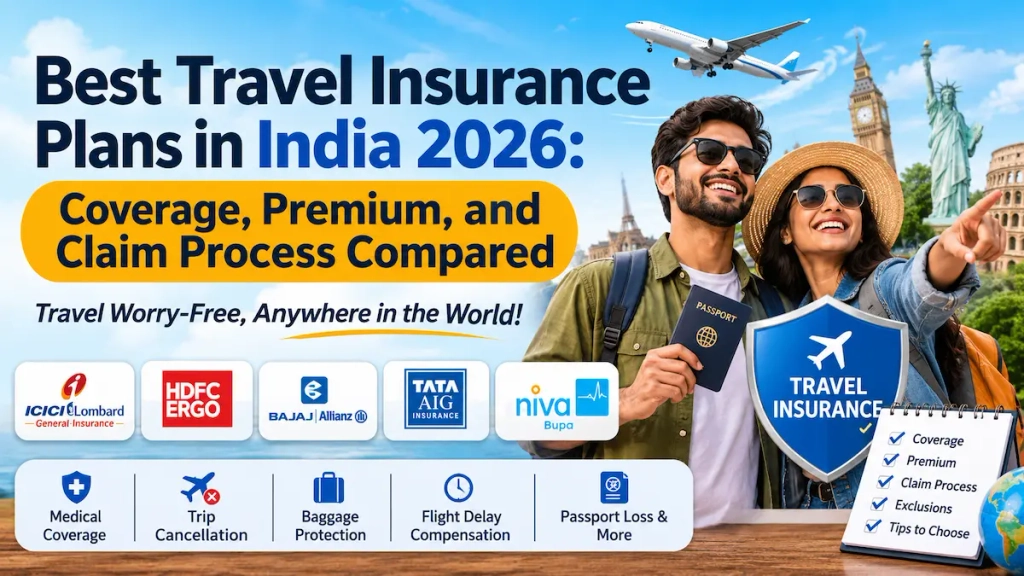
Travel insurance protects Indian travelers from financial losses caused by medical emergencies, trip cancellations, baggage loss, and flight delays during domestic and international trips. This guide compares India’s top 5 travel insurance providers – ICICI Lombard, HDFC ERGO, Bajaj Allianz, Tata AIG, and Niva Bupa – on coverage, premiums, claim settlement ratios, exclusions, and the step-by-step claim process for 2026.
What Does Travel Insurance Cover for Indian Travelers?
Travel insurance covers 6 categories of financial loss: medical emergencies abroad (hospitalization, surgery, evacuation), trip cancellation, baggage loss or delay, flight delay compensation, passport loss, and personal liability. Coverage starts from ₹500 for a 7-day international trip.
Travel insurance is a policy issued by an IRDAI-regulated insurer. IRDAI is the Insurance Regulatory and Development Authority of India, the government body that licenses and regulates all insurance companies operating in India.
Medical Emergency Coverage
Medical emergency coverage pays for hospitalization, surgery, ambulance services, and medical evacuation in foreign countries. This is the most critical coverage component for international travelers.
Sum insured options range from $25,000 to $1,000,000 depending on the plan and provider. A $50,000 sum insured covers most medical emergencies in Southeast Asian countries. Travelers visiting the USA, UK, or Europe need $100,000 to $500,000 due to higher healthcare costs.
Medical evacuation coverage transfers the patient to the nearest adequate hospital or back to India. Evacuation costs reach $50,000 to $200,000 for air ambulance transfers from remote locations. This single coverage component justifies the entire policy premium.
For a detailed breakdown of medical coverage inclusions and exclusions, read our guide on travel medical insurance coverage details.
Trip Cancellation and Interruption
Trip cancellation coverage reimburses non-refundable flight tickets, hotel bookings, and tour packages when a trip is cancelled for covered reasons. Covered reasons include medical emergencies, natural disasters, visa rejection, family bereavement, and airline insolvency.
Trip interruption coverage applies when a trip is cut short after departure. The policy reimburses unused hotel nights, unused tour segments, and additional return flight costs.
Coverage limits range from ₹50,000 to ₹5,00,000 per trip depending on the plan tier. Standard plans cover 100% of pre-paid non-refundable expenses up to the policy limit.
Baggage Loss and Delay
Baggage loss coverage compensates for permanently lost checked luggage. The policyholder submits a Property Irregularity Report (PIR) from the airline and receipts for items in the lost bag. Compensation ranges from ₹25,000 to ₹1,00,000 depending on the plan.
Baggage delay coverage provides a fixed amount for purchasing essentials (clothing, toiletries) when checked baggage arrives late. Most plans activate after a 12-hour delay and pay ₹5,000 to ₹15,000 as a lump sum.
Flight Delay Compensation
Flight delay coverage pays a fixed amount when a flight departs more than 6 to 12 hours late (trigger time varies by insurer). Compensation covers meals, accommodation, and transport during the delay period.
Standard payouts range from ₹2,000 to ₹10,000 per delay event. Some plans pay per hour of delay beyond the trigger threshold. Airline-provided compensation does not reduce the insurance payout in most policies.
For details on insurance coverage specific to flight disruptions, read our guide on travel insurance coverage for flight disruptions.
Passport Loss and Personal Liability
Passport loss coverage reimburses the cost of obtaining an emergency travel document at the nearest Indian Embassy or Consulate. Coverage includes document fees, photographs, and local transport to the embassy. Reimbursement ranges from ₹10,000 to ₹50,000.
Personal liability coverage protects against third-party claims for accidental injury or property damage caused by the policyholder. Limits range from $10,000 to $100,000. This coverage is relevant for rental car damage, hotel property damage, and accidental injury to others.
Which Are the Best Travel Insurance Providers in India for 2026?
ICICI Lombard, HDFC ERGO, Bajaj Allianz, Tata AIG, and Niva Bupa are India’s top 5 travel insurance providers based on coverage range, claim settlement ratio, cashless network size, and premium affordability. These 5 providers account for over 70% of overseas travel policy issuance in India.
| Provider | Top Plan | Sum Insured | Starting Premium | Claim Settlement Ratio | Best For |
|---|---|---|---|---|---|
| ICICI Lombard | TripSecure+ | Up to $500,000 | ₹22/day | ~93% | Cashless treatment abroad |
| HDFC ERGO | Explorer Platinum | $40,000 – $1,000,000 | ₹25/day | 97.45% | Highest claim approval rate |
| Bajaj Allianz | Travel Ace International | Up to $500,000 | ₹13/day | ~90% | Cheapest premiums |
| Tata AIG | Travel Guard Titanium | Up to $1,000,000 | ₹30/day | ~95% | Highest coverage ceiling |
| Niva Bupa | International Travel | Up to $250,000 | ₹28/day | ~92% | Student travel |
Source: IRDAI Annual Report (claim settlement ratios), provider websites (plan details and premiums). Claim settlement ratios are industry-reported figures. Verify current ratios on IRDAI’s published data.
ICICI Lombard TripSecure+
ICICI Lombard is one of India’s largest general insurance companies. TripSecure+ is a modular travel insurance plan. Modular means travelers select coverage components and add-ons based on their trip requirements.
Standout feature: “Cashless Everywhere” allows cashless treatment at both network and non-network hospitals abroad. Non-network hospital reimbursement processes within approximately 4 hours. Most competitors limit cashless treatment to network hospitals only.
TripSecure+ covers medical expenses, trip cancellation, baggage loss, flight delay, and personal accident. Add-on options include adventure sports coverage, rental vehicle excess, and home burglary protection during travel.
HDFC ERGO Explorer and Global Trotter
HDFC ERGO operates the highest claim settlement ratio among major travel insurance providers at 97.45%. This means HDFC ERGO approves and pays 97 out of every 100 claims filed.
Explorer Platinum offers sum insured from $40,000 to $1,000,000. It includes OPD (outpatient department) coverage for doctor consultations and pharmacy expenses abroad without hospitalization. Most competitors exclude OPD from standard plans.
Global Trotter suits frequent travelers with multi-trip annual policies. A single annual premium covers unlimited trips of up to 30, 45, or 90 days each throughout the year.
HDFC ERGO processes claims in-house without third-party administrators (TPAs). In-house processing reduces claim settlement time compared to TPA-dependent insurers.
Bajaj Allianz Travel Ace and Travel Prime
Bajaj Allianz offers the lowest IRDAI-regulated travel insurance premiums in India starting at ₹13 per day.
Travel Ace International covers sum insured up to $500,000 with medical, cancellation, baggage, and delay coverage. This plan suits budget travelers seeking essential coverage at the lowest cost.
Travel Prime International extends coverage up to $1,000,000 with enhanced benefits including hospital daily cash, emergency dental treatment, and hijack distress allowance.
Student-specific plans include tuition fee reimbursement (up to $10,000) for study interruption caused by covered events. This feature is unique among major Indian travel insurers.
Source: Bajaj Allianz website (plan details, student coverage), BankBazaar (premium comparison).
Tata AIG Travel Guard
Tata AIG offers the highest single-plan coverage ceiling in India at $1,000,000 under its Travel Guard Titanium tier. The plan issues instantly online with no medical test requirement for any age group.
Travel Guard comes in 3 tiers: Silver ($50,000), Gold ($250,000), and Titanium ($1,000,000). All tiers cover medical emergency, trip cancellation, baggage, delay, and personal liability. Titanium adds adventure sports, home protection, and emergency cash advance.
Tata AIG’s claim settlement ratio stands at approximately 95%. The company operates a 24/7 global assistance helpline with multilingual support.
Niva Bupa and Reliance General
Niva Bupa (formerly Max Bupa) specializes in health and travel insurance. Its international travel plan suits students going abroad for education. Coverage includes study interruption, sponsor protection (coverage continues if the fee-paying sponsor passes away), and compassionate family visit.
Reliance General is the only major Indian insurer covering travelers up to age 90. This makes it the default choice for senior travelers aged 80+ who are excluded by other providers. Coverage includes pre-existing condition management with appropriate medical documentation.
How Do You Compare Travel Insurance Plans?
Compare travel insurance plans on 8 parameters: sum insured, claim settlement ratio, cashless hospital network, premium cost, coverage exclusions, sub-limits on specific benefits, deductible amounts, and add-on availability. Sum insured and claim settlement ratio carry the highest weight in plan selection.
Use this comparison framework:
| Parameter | What to Check | Why It Matters |
|---|---|---|
| Sum insured | Total maximum payout per trip | Higher sum insured protects against expensive USA/Europe medical bills |
| Claim settlement ratio | Percentage of claims approved and paid | Higher CSR means fewer claim rejections |
| Cashless network | Number of hospitals where insurer pays directly | Cashless eliminates out-of-pocket payment during emergencies |
| Premium | Cost per day or per trip | Lower premium saves money but check coverage quality |
| Exclusions | What the plan does NOT cover | Exclusions determine when claims are denied |
| Sub-limits | Maximum payout for specific benefits (dental, baggage) | A $500,000 plan with a $100 dental sub-limit covers very little dental |
| Deductible | Amount the policyholder pays before insurance activates | Higher deductible means lower premium but more out-of-pocket risk |
| Add-ons | Optional extra coverage (adventure sports, rental car) | Add-ons fill gaps in the base plan |
Never compare plans on premium alone. A ₹13/day plan with $50,000 sum insured and 85% CSR provides less protection than a ₹30/day plan with $500,000 sum insured and 97% CSR.
How Much Does Travel Insurance Cost in India?
Travel insurance premiums for Indian travelers range from ₹500 to ₹4,000 for a 7-day international trip. Premium depends on 5 factors: destination country, trip duration, traveler age, sum insured, and add-on selections. USA and Europe trips cost more than Southeast Asia trips.
Premium by Trip Duration and Destination
| Destination Region | 7-Day Premium | 15-Day Premium | 30-Day Premium |
|---|---|---|---|
| Southeast Asia (Thailand, Bali, Malaysia) | ₹500 – ₹1,500 | ₹800 – ₹2,500 | ₹1,200 – ₹4,000 |
| Middle East (Dubai, Oman) | ₹600 – ₹1,800 | ₹1,000 – ₹3,000 | ₹1,500 – ₹4,500 |
| Europe (Schengen countries) | ₹800 – ₹2,500 | ₹1,500 – ₹4,000 | ₹2,500 – ₹6,500 |
| USA, Canada, UK | ₹1,200 – ₹4,000 | ₹2,500 – ₹6,500 | ₹4,000 – ₹10,000 |
| Worldwide (multi-country) | ₹1,000 – ₹3,500 | ₹2,000 – ₹5,500 | ₹3,500 – ₹9,000 |
Premiums above are for travelers aged 25 to 45 with standard sum insured ($100,000 to $250,000). Senior travelers (60+) pay 2x to 3x higher premiums due to elevated medical risk.
Premium for Specific Trip Scenarios
Scenario 1: 7-day Thailand trip (age 30, $100,000 cover)
- Budget plan (Bajaj Allianz Travel Ace): ₹500 – ₹800
- Mid-range plan (ICICI Lombard TripSecure+): ₹800 – ₹1,200
- Premium plan (Tata AIG Travel Guard Gold): ₹1,200 – ₹1,800
Scenario 2: 15-day Europe Schengen trip (age 35, $250,000 cover)
- Budget plan: ₹1,500 – ₹2,200
- Mid-range plan: ₹2,200 – ₹3,500
- Premium plan: ₹3,500 – ₹5,000
Scenario 3: 30-day USA trip (age 28, $500,000 cover)
- Budget plan: ₹4,000 – ₹5,500
- Mid-range plan: ₹5,500 – ₹7,500
- Premium plan: ₹7,500 – ₹10,000
These are estimated ranges based on 2026 market data. Exact premiums vary by provider. Get quotes from 2 to 3 providers for your specific trip details.
To maximize travel cashback through smart payment methods when purchasing insurance, use a rewards credit card for premium payment.
What Does Travel Insurance NOT Cover?
Travel insurance excludes pre-existing medical conditions (unless declared with an add-on), adventure sports without a rider, routine dental care, pregnancy-related expenses, alcohol or drug-related incidents, self-inflicted injuries, and travel against medical advice.
Understanding exclusions prevents claim rejections. Read the policy wording document before purchasing any plan.
Pre-Existing Medical Conditions
Pre-existing conditions are medical conditions diagnosed or treated before the policy purchase date. Common examples include diabetes, hypertension, asthma, heart disease, and thyroid disorders.
Most travel insurance plans exclude all claims related to pre-existing conditions by default. Travelers with pre-existing conditions must declare them during purchase and buy a pre-existing disease (PED) add-on. The PED add-on increases the premium by 20 to 50 percent.
Failure to declare a pre-existing condition results in claim denial even for unrelated medical emergencies. Insurers investigate medical history during claim processing. A hospitalization for a fracture abroad can be denied when the insurer discovers undeclared diabetes in the claimant’s medical records.
Adventure Sports Without Add-On
Standard travel insurance policies exclude injuries from adventure sports by default. Excluded activities include trekking above 3,000 metres, scuba diving below 10 metres, bungee jumping, paragliding, white-water rafting, skiing, and skydiving.
Adventure sports add-ons cost ₹300 to ₹1,500 per trip depending on the activity type and coverage limit. Add-ons specify altitude limits (up to 6,000 metres for trekking) and depth limits (up to 30 metres for scuba diving).
For detailed coverage options, read our guide on travel insurance coverage for adventure sports.
Other Common Exclusions
8 additional exclusions apply across most Indian travel insurance plans:
- Routine dental treatment – Only emergency dental care (injury or acute pain) is covered. Regular check-ups, fillings, and cleanings are excluded.
- Pregnancy and childbirth – Most plans exclude pregnancy-related hospitalization and delivery expenses entirely.
- Alcohol or drug-related incidents – Claims arising from intoxication or substance use are denied.
- Self-inflicted injuries – Intentional harm and suicide attempts are excluded.
- Travel against medical advice – Traveling after a doctor recommends against it voids coverage.
- War zones and sanctions – Travel to OFAC-sanctioned countries or active war zones is excluded.
- Medical tourism – Traveling specifically for planned medical treatment abroad is not covered.
- Baggage delay under 12 hours – Most plans activate baggage delay coverage only after 12 to 24 hours.
Which Travel Insurance Plan Fits Your Traveler Type?
First-time international travelers need basic medical and cancellation coverage ($100,000 sum insured). Senior citizens need enhanced medical coverage with PED add-on. Students need study interruption and sponsor protection. Families need a single policy covering all members. Adventure travelers need sport-specific add-ons.
For First-Time International Travelers
Recommended: ICICI Lombard TripSecure+ or Bajaj Allianz Travel Ace with $100,000 sum insured.
First-time travelers prioritize medical emergency coverage and trip cancellation protection. A $100,000 sum insured covers hospitalization in most Asian and Middle Eastern countries. Add trip cancellation coverage to protect non-refundable flight and hotel bookings.
Premium estimate: ₹500 to ₹1,500 for a 7-day trip to Southeast Asia.
For Senior Citizens (60+)
Recommended: Reliance General (covers up to age 90) or Tata AIG Travel Guard with PED add-on.
Senior travelers need higher sum insured ($250,000 to $500,000) due to elevated medical costs. Pre-existing condition coverage is essential for travelers with diabetes, hypertension, or heart conditions.
Premium estimate: ₹2,000 to ₹8,000 for a 7-day international trip. Premiums increase with age, reaching 3x the standard rate for travelers above 75.
Reliance General is the only major Indian insurer covering travelers up to age 90. Other providers cap coverage at age 80 to 85.
For detailed plan comparisons for older travelers, read our guide on travel insurance plans for senior citizens.
For Students Going Abroad
Recommended: Niva Bupa International Travel or Bajaj Allianz Student Plan.
Student plans cover academic-year durations (6 to 12 months) at lower annual premiums than standard plans. Key features include tuition fee reimbursement (up to $10,000 with Bajaj Allianz), study interruption coverage, sponsor protection, and compassionate family visit.
Premium estimate: ₹8,000 to ₹25,000 for a 12-month student policy with $100,000 to $250,000 sum insured.
For Families with Children
Recommended: HDFC ERGO Explorer Platinum (family floater option).
Family floater plans cover all family members under a single policy with a shared sum insured. A family of 4 pays approximately 2x to 2.5x the individual premium rather than 4x. Children under 2 years are covered under the parent’s policy at no additional premium with most providers.
Premium estimate: ₹2,000 to ₹6,000 for a 7-day family trip (2 adults + 2 children) to Southeast Asia.
For Adventure and Trekking Travelers
Recommended: Tata AIG Travel Guard Titanium with built-in adventure sports, or ICICI Lombard TripSecure+ with adventure add-on.
Adventure travelers need sport-specific coverage. Verify that the policy covers the exact activity planned. Trekking coverage specifies altitude limits. Scuba diving coverage specifies depth limits. Activities outside the stated limits are excluded.
Premium estimate: ₹1,500 to ₹4,000 for a 7-day trip with adventure sports add-on.
What Insurance Do You Need for a Schengen Visa?
Schengen visa applications require travel insurance with a minimum EUR 30,000 (approximately ₹27,00,000) medical coverage including emergency hospitalization, medical repatriation, and emergency evacuation. The policy must cover the entire trip duration plus a 15-day buffer.
The Schengen Area is a zone of 29 European countries that have abolished internal border controls. Countries include France, Germany, Italy, Spain, Netherlands, Switzerland, Austria, Greece, and 21 others. Indian travelers need a Schengen visa to enter any of these countries.
Schengen visa insurance requirements:
- Minimum medical coverage: EUR 30,000 (this is the legal floor, not a recommended ceiling)
- Coverage scope: Emergency hospitalization, surgery, medication, and repatriation to India
- Validity period: Must cover the entire trip duration including arrival and departure dates
- Geographic scope: Valid across all 29 Schengen countries
- No deductible for medical claims: Some embassies reject policies with medical deductibles
Compliant plans from Indian providers:
| Provider | Schengen-Compliant Plan | Premium (15-day Europe) |
|---|---|---|
| ICICI Lombard | TripSecure+ (EUR 30,000+) | ₹1,500 – ₹3,000 |
| HDFC ERGO | Explorer Platinum ($50,000+) | ₹1,800 – ₹3,500 |
| Bajaj Allianz | Travel Prime ($100,000+) | ₹2,000 – ₹3,800 |
| Tata AIG | Travel Guard Gold ($250,000+) | ₹2,500 – ₹4,500 |
Purchase travel insurance before applying for the Schengen visa. The insurance certificate is a mandatory document in the visa application package.
For complete documentation requirements across visa types, read our guide on travel insurance requirements for visa applications.
How Do You File a Travel Insurance Claim?
Travel insurance claims follow 2 routes: cashless claims (insurer pays the hospital directly during treatment) and reimbursement claims (traveler pays first, insurer repays within 15 to 30 days after returning to India). Both routes require notifying the insurer within 24 to 48 hours of the incident.
Cashless Claims at Network Hospitals
Cashless treatment means the insurer settles the hospital bill directly. The policyholder pays nothing out of pocket at network hospitals. A network hospital is a medical facility with a pre-existing agreement with the insurance company.
Cashless claim process in 5 steps:
- Call the insurer’s 24/7 emergency helpline immediately after hospitalization. The number is printed on the insurance card and policy document.
- Provide the policy number, hospital name, and nature of the medical emergency.
- The insurer sends a pre-authorization form to the hospital’s insurance desk within 2 to 4 hours.
- The hospital treats the patient and bills the insurer directly.
- The policyholder signs the claim form and discharge papers. Pay only for non-covered items (personal items, phone calls, visitor meals).
Critical rule: Notify the insurer within 24 hours of hospitalization and before discharge. Failure to notify within this window voids the cashless facility. The insurer converts the claim to reimbursement mode when notification deadlines are missed.
ICICI Lombard’s “Cashless Everywhere” feature extends cashless treatment to non-network hospitals. The insurer reimburses the hospital within approximately 4 hours. This feature is unique to ICICI Lombard among major Indian providers.
Reimbursement Claims After Returning to India
Reimbursement claims require the policyholder to pay all expenses upfront and file for repayment after returning to India.
Reimbursement claim process in 7 steps:
- Notify the insurer within 48 hours of the incident (medical treatment, baggage loss, trip cancellation).
- Collect all original documents: hospital bills, discharge summary, prescriptions, diagnostic reports, and payment receipts.
- Obtain a doctor’s statement describing the diagnosis and treatment provided.
- File the claim within 30 days after treatment ends.
- Submit the completed claim form with all supporting documents to the insurer (online portal or physical submission).
- The insurer reviews documents and requests additional information within 15 days.
- Approved claims are settled within 15 to 30 days after the insurer receives all required documents.
Source: ICICI Lombard (claim process), Royal Sundaram (settlement timeline), Bajaj Allianz (documentation requirements).
Documents Required for Different Claim Types
| Claim Type | Documents Required |
|---|---|
| Medical emergency | Claim form, policy copy, passport with entry/exit stamps, boarding pass, original hospital bills, discharge summary, diagnostic reports, doctor’s statement, pharmacy receipts |
| Trip cancellation | Claim form, booking confirmation, cancellation proof, medical certificate (for medical cancellation), airline/hotel cancellation confirmation, payment receipts for cancelled bookings |
| Baggage loss | Claim form, Property Irregularity Report (PIR) from airline, list of lost items with approximate values, purchase receipts for items (where available), airline correspondence |
| Flight delay | Claim form, boarding pass, airline communication confirming delay duration, receipts for meals and accommodation during delay |
| Passport loss | Claim form, FIR copy from local police, Indian Embassy emergency certificate, receipts for replacement document fees |
Keep photocopies of all submitted documents. Maintain a soft copy (photographs or scans) of every original document before submission. Insurers do not return original documents after processing.
For a complete walkthrough of the claim process, read our complete travel insurance claim process guide.
What Are 8 Things to Check Before Buying Travel Insurance?
Check these 8 parameters before purchasing any travel insurance plan: sum insured adequacy, claim settlement ratio, cashless hospital availability, exclusions list, sub-limits on specific benefits, deductible amount, policy wording language, and 24/7 assistance helpline availability.
- Sum insured matches destination costs. A $50,000 plan works for Thailand. The USA needs $250,000 or more. Medical costs in US hospitals reach $10,000 per day for ICU admission.
- Claim settlement ratio exceeds 90%. A CSR below 90% indicates that 1 in 10 claims is rejected. HDFC ERGO leads at 97.45%. Verify the latest CSR on the IRDAI website.
- Cashless hospitals exist at your destination. Check the insurer’s hospital network in the specific city you are visiting. A network of 10,000 hospitals worldwide means nothing when none are in Phuket or Bali.
- Exclusions are clearly listed. Read the policy wording document (not the marketing brochure). Check exclusions for pre-existing conditions, adventure sports, and alcohol-related incidents.
- Sub-limits do not undercut coverage. A $500,000 plan with a $500 baggage loss sub-limit provides minimal baggage protection. Check sub-limits for dental, baggage, delay, and personal liability.
- Deductible is acceptable. A ₹5,000 deductible means the first ₹5,000 of every claim comes from your pocket. Lower deductibles cost higher premiums. Choose based on your risk tolerance.
- Policy wording is in English and clearly written. The policy wording document is the legal contract. Marketing summaries and comparison websites are not binding. Download and read the actual policy wording before purchase.
- 24/7 assistance helpline operates in your time zone. Medical emergencies happen at any hour. Verify that the helpline provides English-speaking support and can coordinate hospital admission in the destination country.
FAQs About Travel Insurance in India
Is Travel Insurance Worth Buying for International Trips?
Yes. A single emergency hospitalization abroad costs ₹5,00,000 to ₹50,00,000 depending on the country. Travel insurance covering that risk costs ₹500 to ₹4,000 for a 7-day trip. The cost-to-coverage ratio makes travel insurance one of the highest-value purchases in international trip planning.
Does Travel Insurance Cover COVID-19?
Yes, with conditions. Most Indian travel insurance providers cover COVID-19 hospitalization abroad as part of standard medical emergency coverage since 2023. Quarantine hotel costs and trip cancellation due to COVID diagnosis are covered by select plans with a pandemic add-on. Verify COVID-specific coverage in the policy wording before purchase.
Can I Buy Travel Insurance After Booking My Flight?
Yes. Travel insurance can be purchased any time before departure. Purchase at least 48 hours before travel for immediate policy activation. Some trip cancellation benefits require purchase within 48 hours of booking flights for full coverage of pre-departure cancellation events.
How Much Travel Insurance Coverage Do I Need?
$50,000 to $100,000 for Southeast Asia and Middle East. $100,000 to $250,000 for Europe (Schengen minimum is EUR 30,000). $250,000 to $500,000 for USA, Canada, and UK. These ranges reflect actual hospitalization costs in each region. Higher coverage costs marginally more in premium but protects against catastrophic medical bills.
Does Credit Card Travel Insurance Replace a Standalone Policy?
No. Credit card travel insurance provides limited coverage (typically $10,000 to $50,000 sum insured) with higher exclusions and lower claim settlement support. Standalone policies offer 5x to 20x higher coverage, dedicated 24/7 assistance helplines, cashless treatment networks, and comprehensive documentation support. Credit card insurance works as supplementary coverage, not as a replacement.
Sources: IRDAI Annual Report (irdai.gov.in), ICICI Lombard (icicilombard.com), HDFC ERGO (hdfcergo.com), Bajaj Allianz (bajajallianz.com), Tata AIG (tataaig.com), Niva Bupa (nivabupa.com), Reliance General (reliancegeneral.co.in), BankBazaar (bankbazaar.com), JoinDitto (joinditto.in), Royal Sundaram (royalsundaram.in)